- Ana Sayfa
- Reinforcing Steel Mesh
Reinforcing Steel Mesh
Reinforcing Steel Mesh – Q & R Type Welded Wire Mesh for Concrete
Reinforcing steel mesh, also known as welded wire mesh or steel reinforcing mesh, is a factory-prefabricated concrete reinforcement mesh used in slabs, foundations, walls and industrial floors. It provides fast installation, crack control and uniform load distribution in reinforced concrete.
HL Metal supplies Q-type, R-type and custom reinforcing steel mesh manufactured from cold-drawn ST I grade ribbed wire. Wires are straightened, cut to length and placed perpendicular at fixed spacing, then joined by spot welding to form durable welded reinforcement mesh panels ready for concrete pouring.
We offer standard Q and R meshes with detailed weight tables, as well as project-specific rebar mesh designs for tunnel formwork, mine mesh, wall mesh and support mesh.
What Is Reinforcing Steel Mesh?
Reinforcing steel mesh (also called welded wire mesh, steel reinforcement mesh or BRC mesh) is produced by drawing coiled ST I grade steel through a cold-drawing process to improve its physical properties. The material is then straightened and cut to required lengths, forming high-strength ribbed steel rods.
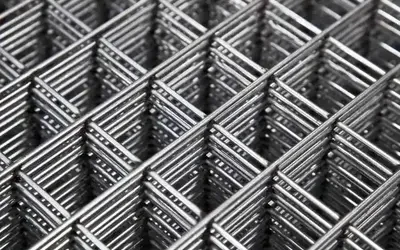
These longitudinal and transverse rods are placed perpendicular to each other at specified spacings and joined together by automatic spot welding. The result is a welded reinforcement mesh panel which acts as primary reinforcement in concrete slabs, rafts, beams, walls and industrial floors.
In modern construction, concrete reinforcing mesh replaces time-consuming tying of loose bars, reducing labour, errors and waste while providing consistent reinforcement quality.
Main Reinforcing Steel Mesh Types
- Q-type reinforcing steel mesh – standard welded mesh with equal spacings for slabs and walls
- R-type reinforcing steel mesh – mesh with different spacings for main and distribution directions
- Custom reinforcing steel meshes – tailored to project drawings and loading conditions
Whether you need slab reinforcing mesh, foundation mesh or tunnel reinforcing mesh, HL Metal can supply standard or custom welded wire mesh for concrete with fast delivery and export-ready packing.
Types of Reinforcing Steel Mesh Supplied by HL Metal
HL Metal offers a complete range of reinforcing steel mesh solutions for building, infrastructure and tunnel projects:
- Q-type reinforcing steel mesh: standard welded reinforcement mesh for slabs, shear walls, retaining walls, foundations, industrial floor concretes, tunnels, galleries, channels and drainage systems.
- R-type reinforcing steel mesh: mesh with differing spacings in each direction, ideal for slabs and foundations where main reinforcement differs from distribution reinforcement.
- Custom reinforcing steel meshes: project-specific meshes manufactured according to cm²/m steel area, bar diameters, spacings and panel dimensions.
Our welded steel mesh panels can be designed as mine mesh, wall mesh and support mesh in tunnel formwork systems, ensuring safe and fast installation on site.
Advantages of Reinforcing Steel Mesh in Concrete Structures
Using reinforcing steel mesh instead of loose rebar offers major technical and economic advantages:
- Fast installation: Large welded panels cover more area than individual bars, reducing reinforcement time on site.
- Improved crack control: Regular wire spacing ensures uniform distribution of reinforcement, helping to limit crack widths in slabs and walls.
- Higher consistency: Factory-controlled welded reinforcement mesh ensures correct spacing, wire diameters and steel area per metre.
- Lower labour cost: Less tying and cutting work; site teams can install mesh with fewer workers.
- Reduced steel waste: Optimized panel sizes and custom-designed meshes minimise offcuts and scrap.
- Safer handling: Flat panels are easy to move, stack and lift compared with bundles of loose bars.
For large slab projects, industrial floors and housing systems, switching to reinforcing steel mesh panels significantly improves both productivity and quality.
Applications of Reinforcing Steel Mesh
Steel reinforcing mesh is widely used wherever reinforced concrete needs controlled cracking and reliable load transfer:
Building & Residential Projects
- Slab-on-grade and suspended slabs
- Shear walls and core walls
- Retaining walls and basement walls
- Foundations, raft foundations and strip footings
- Balconies, stair landings and galleries
Industrial & Infrastructure Projects
- Industrial floor concretes and warehouse slabs
- Road pavements and yard slabs
- Channels, drainage systems and culverts
- Water tanks, treatment plants and reservoirs
Tunnels, Mines & Support Meshes
- Tunnel formwork systems and shotcrete reinforcement
- Mine mesh, wall mesh and support mesh
- Lining meshes for underground structures
For external perimeter security and landscape applications, you can also check our fence and mesh products such as grass fence, cage wire mesh, fence mesh, panel fence and chain-link fence via the links in the Related Mesh & Fence Products section.
Production Process & Quality Standards
HL Metal works with mills and mesh producers that apply strict quality control to reinforcing steel mesh production:
- Material: ST I grade cold-drawn ribbed wire for improved yield strength and bond to concrete.
- Cold drawing: Coiled steel wire is drawn through dies to increase strength and obtain ribbed profile.
- Straightening & cutting: Wires are straightened and cut to required lengths for longitudinal and transverse directions.
- Automatic welding: Spot welding at each intersection forms durable welded wire mesh panels with fixed spacing.
- Inspection: Checks on wire diameter, spacing, panel dimensions and weld quality to meet project specifications.
On request, HL Metal can provide material test certificates and documentation for reinforcing mesh shipments, together with export packing, labelling and loading plans suitable for road or container transport.
Q-Type Reinforcing Steel Mesh – Technical Data & Weight Table
Q-type reinforcing steel mesh is widely used as reinforcement in slabs, shear walls, retaining walls, foundations, industrial floor concretes, tunnels, galleries, channels and drainage systems. It is manufactured by welding cold-drawn, ribbed, high-strength rods at fixed spacing, providing enhanced structural integrity and reducing labour time on site.
The table below shows typical Q-type welded reinforcement mesh dimensions, apertures, wire diameters and theoretical weights.
| Mesh Type | Mesh Dimensions W/L (cm) | Mesh Aperture W/L (mm) | Wire Diameter W/L (mm) | Protruding Wires W/L (mm) | Panel Weight (kg) | Weight (kg/m²) |
|---|---|---|---|---|---|---|
| Q106/106 | 500/215 | 150/150 | 4.5/4.5 | 100/100 – 25/175 | 17,62 | 1,66 |
| Q131/131 | 500/215 | 150/150 | 5.0/5.0 | 100/100 – 25/175 | 21,70 | 2,06 |
| Q158/158 | 500/215 | 150/150 | 5.5/5.5 | 100/100 – 25/175 | 26,36 | 2,49 |
| Q188/188 | 500/215 | 150/150 | 6.0/6.0 | 100/100 – 25/175 | 31,29 | 2,96 |
| Q221/221 | 500/215 | 150/150 | 6.5/6.5 | 100/100 – 25/175 | 36,65 | 3,47 |
| Q257/257 | 500/215 | 150/150 | 7.0/7.0 | 100/100 – 25/175 | 42,57 | 4,03 |
| Q257/188 | 500/215 | 150/150 | 7.0/6.0 | 100/100 – 25/175 | 36,89 | 3,49 |
| Q295/295 | 500/215 | 150/150 | 7.5/7.5 | 100/100 – 25/175 | 48,91 | 4,62 |
| Q295/257 | 500/215 | 150/150 | 7.5/7.0 | 100/100 – 25/175 | 45,72 | 4,33 |
| Q295/221 | 500/215 | 150/150 | 7.5/6.5 | 100/100 – 25/175 | 42,73 | 4,04 |
| Q295/188 | 500/215 | 150/150 | 7.5/6.0 | 100/100 – 25/175 | 40,04 | 3,79 |
| Q295/158 | 500/215 | 150/150 | 7.5/5.5 | 100/100 – 25/175 | 37,55 | 3,56 |
| Q317/317 | 500/215 | 150/150 | 7.8/7.8 | 100/100 – 25/175 | 52,86 | 5,00 |
| Q317/295 | 500/215 | 150/150 | 7.8/7.5 | 100/100 – 25/175 | 50,80 | 4,81 |
| Q317/257 | 500/215 | 150/150 | 7.8/7.0 | 100/100 – 25/175 | 47,61 | 4,52 |
| Q317/221 | 500/215 | 150/150 | 7.8/6.5 | 100/100 – 25/175 | 44,63 | 4,24 |
| Q317/188 | 500/215 | 150/150 | 8.0/6.0 | 100/100 – 25/175 | 42,00 | 3,98 |
| Q335/335 | 500/215 | 150/150 | 8.0/8.0 | 100/100 – 25/175 | 55,68 | 5,26 |
| Q335/317 | 500/215 | 150/150 | 8.0/7.8 | 100/100 – 25/175 | 54,18 | 5,13 |
| Q335/295 | 500/215 | 150/150 | 8.0/7.5 | 100/100 – 25/175 | 52,27 | 4,94 |
| Q335/257 | 500/215 | 150/150 | 8.0/7.0 | 100/100 – 25/175 | 49,08 | 4,64 |
| Q335/221 | 500/215 | 150/150 | 8.0/6.5 | 100/100 – 25/175 | 46,09 | 4,37 |
| Q335/188 | 500/215 | 150/150 | 8.0/6.0 | 100/100 – 25/175 | 43,40 | 4,11 |
| Q377/377 | 500/215 | 150/150 | 8.5/8.5 | 100/100 – 25/175 | 62,72 | 5,94 |
| Q377/335 | 500/215 | 150/150 | 8.5/8.0 | 100/100 – 25/175 | 59,17 | 5,60 |
| Q377/317 | 500/215 | 150/150 | 8.5/7.8 | 100/100 – 25/175 | 57,69 | 5,47 |
| Q377/295 | 500/215 | 150/150 | 8.5/7.5 | 100/100 – 25/175 | 55,77 | 5,28 |
| Q377/257 | 500/215 | 150/150 | 8.5/7.0 | 100/100 – 25/175 | 52,58 | 4,98 |
| Q377/221 | 500/215 | 150/150 | 8.5/6.5 | 100/100 – 25/175 | 49,60 | 4,71 |
| Q377/188 | 500/215 | 150/150 | 8.5/6.0 | 100/100 – 25/175 | 46,90 | 4,45 |
| Q424/424 | 500/215 | 150/150 | 9.0/9.0 | 100/100 – 25/175 | 70,33 | 6,66 |
| Q424/377 | 500/215 | 150/150 | 9.0/8.5 | 100/100 – 25/175 | 66,50 | 6,30 |
| Q424/335 | 500/215 | 150/150 | 9.0/8.0 | 100/100 – 25/175 | 62,96 | 5,96 |
| Q424/317 | 500/215 | 150/150 | 9.0/7.8 | 100/100 – 25/175 | 61,47 | 5,98 |
| Q424/295 | 500/215 | 150/150 | 9.0/7.5 | 100/100 – 25/175 | 59,55 | 5,64 |
| Q424/257 | 500/215 | 150/150 | 9.0/7.0 | 100/100 – 25/175 | 56,36 | 5,34 |
| Q424/221 | 500/215 | 150/150 | 9.0/6.5 | 100/100 – 25/175 | 53,38 | 5,07 |
| Q443/443 | 500/215 | 150/150 | 9.2/9.2 | 100/100 – 25/175 | 73,58 | 6,96 |
| Q443/377 | 500/215 | 150/150 | 9.2/8.5 | 100/100 – 25/175 | 67,97 | 6,45 |
| Q443/335 | 500/215 | 150/150 | 9.2/8.0 | 100/100 – 25/175 | 64,42 | 6,11 |
| Q443/317 | 500/215 | 150/150 | 9.2/7.8 | 100/100 – 25/175 | 62,94 | 5,98 |
| Q443/295 | 500/215 | 150/150 | 9.2/7.5 | 100/100 – 25/175 | 61,02 | 5,79 |
| Q443/257 | 500/215 | 150/150 | 9.2/7.0 | 100/100 – 25/175 | 57,83 | 5,49 |
| Q443/221 | 500/215 | 150/150 | 9.2/6.5 | 100/100 – 25/175 | 54,99 | 5,22 |
| Q473/473 | 500/215 | 150/150 | 9.5/9.5 | 100/100 – 25/175 | 78,37 | 7,42 |
| Q503/503 | 500/215 | 100/100 | 8.0/8.0 | 100/100 – 25/125 | 83,09 | 7,89 |
| Q513/513 | 500/215 | 100/100 | 8.1/8.1 | 100/100 – 25/125 | 85,20 | 8,09 |
| Q513/257 | 500/215 | 100/150 | 8.1/7.0 | 100/100 – 25/125 | 63,96 | 6,06 |
| Q524/524 | 500/215 | 150/150 | 10.0/10.0 | 100/100 – 25/175 | 86,97 | 8,22 |
| Q524/443 | 500/215 | 150/150 | 10.0/9.2 | 100/100 – 25/175 | 80,08 | 7,59 |
| Q524/424 | 500/215 | 150/150 | 10.0/9.0 | 100/100 – 25/175 | 78,60 | 7,44 |
| Q524/377 | 500/215 | 150/150 | 10.0/8.5 | 100/100 – 25/175 | 74,76 | 7,08 |
| Q524/335 | 500/215 | 150/150 | 10.0/8.0 | 100/100 – 25/175 | 71,21 | 6,74 |
| Q524/317 | 500/215 | 150/150 | 10.0/7.8 | 100/100 – 25/175 | 69,72 | 6,61 |
| Q524/295 | 500/215 | 150/150 | 10.0/7.5 | 100/100 – 25/175 | 67,81 | 6,42 |
| Q524/257 | 500/215 | 150/150 | 10.0/7.0 | 100/100 – 25/175 | 64,62 | 6,12 |
| Q589/589 | 500/215 | 150/150 | 10.6/10.6 | 100/100 – 25/175 | 97,53 | 9,24 |
| Q589/589 | 500/215 | 100/100 | 8.7/8.7 | 100/100 – 25/125 | 98,24 | 9,33 |
| Q589/503 | 500/215 | 100/100 | 8.7/8.0 | 100/100 – 25/125 | 90,65 | 8,61 |
| Q589/378 | 500/215 | 100/150 | 8.7/8.5 | 100/100 – 25/125 | 80,61 | 7,64 |
| Q589/335 | 500/215 | 100/150 | 8.7/8.0 | 100/100 – 25/125 | 76,96 | 7,30 |
| Q589/317 | 500/215 | 100/150 | 8.7/7.8 | 100/100 – 25/125 | 75,47 | 7,17 |
| Q589/295 | 500/215 | 100/150 | 8.7/7.5 | 100/100 – 25/125 | 73,66 | 6,98 |
| Q634/634 | 500/215 | 150/150 | 11.0/11.0 | 100/100 – 25/175 | 105,15 | 9,95 |
| Q636/636 | 500/215 | 100/100 | 9.0/9.0 | 100/100 – 25/125 | 104,96 | 9,99 |
| Q636/424 | 500/215 | 100/150 | 9.0/9.0 | 100/100 – 25/125 | 87,80 | 8,32 |
| Q709/424 | 500/215 | 100/150 | 9.5/9.0 | 100/100 – 25/125 | 93,78 | 8,89 |
| Q754/754 | 500/215 | 150/150 | 12.0/12.0 | 100/100 – 25/175 | 125,16 | 11,84 |
| Q785/785 | 500/215 | 100/100 | 10.0/10.0 | 100/100 – 25/125 | 129,79 | 12,33 |
| Q785/295 | 500/215 | 100/150 | 10.0/7.5 | 100/100 – 25/125 | 89,40 | 8,48 |
| Q785/257 | 500/215 | 100/150 | 10.0/7.0 | 100/100 – 25/125 | 86,21 | 8,18 |
| Q950/950 | 500/215 | 100/100 | 11.0/11.0 | 100/100 – 25/125 | 156,92 | 14,92 |
| Q1131/1131 | 500/215 | 100/100 | 12.0/12.0 | 100/100 – 25/125 | 186,78 | 17,76 |
Note: Values are theoretical. For project-specific Q-type reinforcing steel mesh, alternative spacings and custom panel sizes, please share your slab or wall details with HL Metal.
R-Type Reinforcing Steel Mesh – Technical Data & Weight Table
R-type reinforcing steel mesh is designed with different spacings in each direction and is used for thicker slab and foundation applications. For thicker mesh types, edge reductions are not applied by default. Upon request, edge trimming can be implemented to minimise material loss along the mesh perimeter.
| Mesh Type | Mesh Dimensions W/L (cm) | Mesh Spacing W/L (mm) | Wire Diameter W/L (mm) | Protruding Wires W/L (mm) | Panel Weight (kg) | Weight (kg/m²) |
|---|---|---|---|---|---|---|
| R 106 | 500/215 | 150/250 | 4.5/4.5 | 125/125 – 25/175 | 14,12 | 1,33 |
| R 131 | 500/215 | 150/250 | 5.0/5.0 | 125/125 – 25/175 | 17,40 | 1,64 |
| R 158 | 500/215 | 150/250 | 5.5/5.0 | 125/125 – 25/175 | 19,71 | 1,86 |
| R 188 | 500/215 | 150/250 | 6.0/5.0 | 125/125 – 25/175 | 22,16 | 2,10 |
| R 221 | 500/215 | 150/250 | 6.5/5.0 | 125/125 – 25/175 | 24,82 | 2,35 |
| R 257 | 500/215 | 150/250 | 7.0/5.0 | 125/125 – 25/175 | 27,76 | 2,63 |
| R 295 | 500/215 | 150/250 | 7.5/5.0 | 125/125 – 25/175 | 30,91 | 2,93 |
| R 317 | 500/215 | 150/250 | 7.8/5.0 | 125/125 – 25/175 | 32,87 | 3,12 |
| R 335 | 500/215 | 150/250 | 8.0/5.0 | 125/125 – 25/175 | 34,27 | 3,25 |
| R 377 | 500/215 | 150/250 | 8.5/5.5 | 125/125 – 25/175 | 39,19 | 3,72 |
| R 390 | 500/215 | 150/250 | 8.7/5.5 | 125/125 – 25/175 | 40,66 | 3,86 |
| R 424 | 500/215 | 150/250 | 9.0/5.5 | 125/125 – 25/175 | 42,97 | 4,08 |
| R 443 | 500/215 | 150/250 | 9.2/5.5 | 125/125 – 25/175 | 44,58 | 4,22 |
| R 473 | 500/215 | 150/250 | 9.5/5.5 | 125/125 – 25/175 | 46,96 | 4,46 |
| R 503 | 500/215 | 100/250 | 8.0/6.0 | 125/125 – 25/125 | 51,02 | 4,83 |
| R 513 | 500/215 | 100/250 | 8.1/6.0 | 125/125 – 25/125 | 52,07 | 4,93 |
| R 524 | 500/215 | 150/250 | 10.0/6.0 | 125/125 – 25/175 | 52,74 | 4,99 |
| R 567 | 500/215 | 100/250 | 8.5/6.0 | 125/125 – 25/125 | 56,27 | 5,34 |
| R 577 | 500/215 | 100/250 | 8.6/6.5 | 125/125 – 25/125 | 59,06 | 5,45 |
| R 577 | 500/215 | 150/250 | 10.5/6.5 | 125/125 – 25/175 | 58,78 | 5,57 |
| R 589 | 500/215 | 100/250 | 8.7/6.5 | 125/125 – 25/125 | 60,22 | 5,71 |
| R 589 | 500/215 | 150/250 | 10.6/6.5 | 125/125 – 25/175 | 59,69 | 5,66 |
| R 634 | 500/215 | 150/250 | 11.0/6.5 | 125/125 – 25/175 | 63,40 | 6,02 |
| R 636 | 500/215 | 100/250 | 9.0/6.5 | 125/125 – 25/125 | 63,57 | 6,04 |
| R 709 | 500/215 | 100/250 | 9.5/6.5 | 125/125 – 25/125 | 69,56 | 6,61 |
| R 785 | 500/215 | 100/250 | 10.0/6.5 | 125/125 – 25/125 | 75,97 | 7,21 |
| R 866 | 500/215 | 100/250 | 10.5/7.0 | 125/125 – 25/125 | 84,39 | 8,01 |
Note: For thicker R-type meshes, edge reductions are not applied by default. On request, HL Metal can supply edge-trimmed reinforcing mesh to reduce material loss along mesh edges.
Custom Reinforcing Steel Meshes
Custom reinforcing steel meshes are manufactured according to project requirements in any cross-section (cm²/m), with:
- Maximum bar length: 12 metres
- Maximum bar width: 3.20 metres
- Bar diameter range: 3 mm – 12 mm
- Mesh spacing options: 50 mm, 75 mm, 100 mm and their multiples
Steel meshes used in tunnel formwork systems – such as mine mesh, wall mesh and support mesh – are considered custom meshes and are produced directly according to project drawings and specifications.
By sharing your reinforcement drawings, slab thicknesses, loads and cover requirements, you can obtain an optimised custom reinforcing steel mesh solution that reduces cutting, bending and tying work on site.
Related Mesh & Fence Products
In addition to reinforcing steel mesh for concrete, HL Metal supplies various wire mesh and fence systems for perimeter security, industrial facilities and landscaping:
- Grass Fence Systems
- Cage Wire Mesh
- Fence Mesh Panels
- Panel Fence Systems
- Decorative Grass Fence Solutions
- Chain-Link Fence (Wire Mesh Fence)
Combining reinforcing steel mesh with appropriate fence mesh systems helps contractors cover both structural reinforcement and perimeter security from a single supplier.
Need Reinforcing Steel Mesh for Your Next Concrete Project?
Share your required mesh type (Q / R / custom), wire diameters, spacings, panel sizes, concrete class and delivery address/port. HL Metal will prepare a tailored reinforcing steel mesh offer including competitive pricing, lead time, packaging details and documentation – ready for export.
📧 Send Your Reinforcing Steel Mesh Inquiry
Our team can combine Q-type and R-type meshes with custom mesh, wire mesh fences and other steel products in one optimised shipment. Contact us today to receive a project-specific proposal for your concrete reinforcing mesh needs.
Contact HL Metal – Request Reinforcing Steel Mesh QuoteReinforcing steel mesh, steel reinforcement mesh, concrete reinforcing mesh, welded steel mesh, construction reinforcement mesh, structural steel mesh, HL Metal Demir Çelik reinforcing mesh, durable steel mesh, industrial steel reinforcement, and export-quality reinforcing mesh are essential components in the modern construction industry. These materials play a critical role in providing strength, stability, and durability to concrete structures, ensuring long-lasting performance under various loads and conditions.
At HL Metal Demir Çelik Sanayi, we specialize in supplying high-quality reinforcing steel mesh tailored to meet the demands of industrial, commercial, and infrastructure projects. Our steel reinforcement mesh and welded steel mesh products are manufactured using precision techniques, ensuring consistent mesh apertures, accurate dimensions, and superior tensile strength. Whether for small-scale residential projects or large-scale industrial and highway works, our durable steel mesh solutions are designed to perform reliably.
Concrete reinforcing mesh from HL Metal is used in foundations, floors, walls, pavements, and precast concrete elements, providing excellent crack control and load distribution. Our structural steel mesh meets international standards, making it suitable for export-quality reinforcing mesh applications across global markets.
HL Metal’s construction reinforcement mesh is available in various wire diameters, mesh sizes, and panel dimensions, ensuring flexibility and adaptability for project-specific needs. With a strong focus on quality control and technical support, HL Metal Demir Çelik reinforcing mesh products help customers achieve superior construction outcomes.
By choosing HL Metal’s industrial steel reinforcement solutions, clients gain access to proven expertise, durable materials, and export-ready products trusted by professionals worldwide. Whether you need standard panels or custom-made mesh, HL Metal delivers steel reinforcement mesh solutions that enhance the safety, durability, and performance of every construction project.
Reinforcing Steel Mesh — Advanced Reinforcement for Durable Concrete Structures
Executive summary and product overview
Reinforcing Steel Mesh is an engineered solution that enhances concrete tensile performance and controls crack propagation across slabs, walls and foundations. Also commonly referred to as Steel Reinforcement Mesh, Reinforcement Mesh or Rebar Mesh, this product is widely adopted across residential, commercial and heavy civil projects due to its repeatable quality, predictable performance and rapid site installation. Whether you are sourcing Welded Steel Mesh for Reinforcement in panel form (Welded Reinforcing Mesh Panels) or specifying bespoke configurations as Custom Size Reinforcing Steel Mesh, mesh reinforcement provides a pragmatic alternative to individually tied rebar in many applications.
This technical and commercial guide outlines the principal types — including Square Reinforcing Mesh and Rectangular Reinforcing Mesh — production methods such as Hot Rolled Reinforcement Mesh and Cold Drawn Reinforcing Mesh, performance characteristics for High Strength Reinforcing Mesh and Durability options like Corrosion Resistant Reinforcement Mesh, practical selection criteria for Reinforcing Mesh for Concrete Slabs and Reinforcing Mesh for Foundations, and procurement guidance for working with a Reinforcing Steel Mesh Supplier or Reinforcing Mesh Manufacturer.
Product types, manufacturing and material science
Welded vs. alternate construction
Welded Steel Mesh for Reinforcement is manufactured by intersecting longitudinal and transverse wires and spot-welding at junctions. Welded Reinforcing Mesh Panels are commonly supplied in standardized dimensions but can be fabricated to project-specific sizes. In contrast, other reinforcement systems use individually placed rebar or woven systems. Welded mesh provides uniform spacing and consistent mechanical behavior which is ideal for repeatable applications such as Reinforcing Steel Mesh for Flooring or Steel Mesh for Road Construction.
Wire metallurgy and process
Production methods influence mechanical properties. Hot Rolled Reinforcement Mesh provides ductility and toughness suitable for heavy-duty applications (often categorized as Heavy Duty Reinforcing Mesh). Cold Drawn Reinforcing Mesh typically yields higher yield strengths and better dimensional tolerances. Material selection should reference project specifications and local codes when choosing between Hot Rolled Reinforcement Mesh or Cold Drawn Reinforcing Mesh.
Geometries and sizes
Standard Size Reinforcing Mesh is available in common grid patterns — for example 50 mm x 50 mm or 100 mm x 100 mm — but many projects demand Custom Size Reinforcing Steel Mesh to account for architectural constraints, embeds or irregular slab perimeters. Square Reinforcing Mesh offers symmetric structural response while Rectangular Reinforcing Mesh can be used where directional stiffness is required.
Key applications and domain-specific recommendations
Reinforcement Mesh is specified across a broad portfolio of structural work. Typical uses include:
- Reinforcing Mesh for Concrete Slabs: industrial floors, warehouse decks and domestic ground slabs where uniform crack control is required.
- Reinforcing Mesh for Foundations: raft foundations and slab-on-grade where distribution of tensile stresses improves serviceability.
- Reinforcement Mesh for Walls: thin reinforced walls, precast panels and retaining structures.
- Reinforcing Steel Mesh for Flooring: overlays, toppings and suspended slab systems.
- Steel Mesh for Road Construction: pavement repairs, overlays and structural asphalt or concrete layers requiring crack suppression.
- Reinforcing Mesh for Tunnels and Bridges: specialized grades (High Strength Reinforcing Mesh and Corrosion Resistant Reinforcement Mesh) for demanding infrastructure applications.
For each application, coordinate with our Engineering Services for load-based selection, cover requirements and detailing.
Performance attributes and specification drivers
Strength & serviceability
High Strength Reinforcing Mesh improves ultimate capacity, while carefully selected mesh spacing and wire diameter mitigate serviceability problems such as deflection and cracking. Long-lasting Reinforcement Mesh designs focus not only on initial capacity but on sustained performance under environmental exposure and cyclic loading.
Durability & corrosion protection
Corrosion Resistant Reinforcement Mesh is available via galvanizing, epoxy coating or stainless-steel wire to address chloride exposure, coastal atmospheres or chemically aggressive soils. Durable Reinforcing Steel Mesh products reduce life-cycle costs and maintenance interventions.
Constructability
Welded Reinforcing Mesh Panels accelerate installation, reduce labor hours and minimize on-site tying. For large-volume orders, Wholesale Reinforcing Steel Mesh procurement and working with a reputable Reinforcing Mesh Stockist can reduce lead times and unit costs.
Procurement: how to engage suppliers and compare offers
When sourcing reinforcement, evaluate potential partners on technical capability, quality control, certification and logistics. Ask prospective vendors for the following:
- Batch test certificates and tensile properties for the proposed Rebar Mesh or Welded Steel Mesh for Reinforcement.
- Dimensional plans for Welded Reinforcing Mesh Panels and confirmation of Standard Size Reinforcing Mesh availability.
- Options for Custom Size Reinforcing Steel Mesh and associated lead times.
- Evidence of corrosion protection treatments where Corrosion Resistant Reinforcement Mesh is specified.
Typical supplier roles include Reinforcing Steel Mesh Supplier, Reinforcing Mesh Manufacturer and, for international projects, Reinforcement Mesh Exporter. For e-commerce buyers, choose licensed channels to Buy Reinforcement Mesh Online and verify freight terms before accepting quotes. If your project is bulk-oriented, contact our wholesale desk for competitive Wholesale Reinforcing Steel Mesh pricing and logistics.
Installation best practices
Positioning and cover
Correct positioning is critical. Reinforcing Mesh for Concrete Slabs must be supported to maintain the specified concrete cover; incorrect cover reduces durability and compromises performance. Overlap (lap length) recommendations should follow project-specific engineering guidance — for Welded Reinforcing Mesh Panels, lap details differ from rebar lap schedules.
Cutting, bending and field modifications
Cutting or re-shaping mesh in the field must be executed with suitable tools and by trained personnel. Cold Drawn Reinforcing Mesh and Hot Rolled Reinforcement Mesh respond differently to bending; over-manipulation of higher-strength wire may create brittle zones and should be avoided without engineering consent.
Coordination with other trades
Ensure coordination with electrical and plumbing trades to avoid penetrations through reinforcement that can create stress concentrations. Preplanning reduces rework and maintains the integrity of the Reinforced Steel Mesh in the finished slab or wall.
Comparative analysis: Rebar Mesh vs. conventional bar reinforcement
Rebar Mesh (prefabricated grid) is often faster to install than individually tied bars and provides consistent spacing which enhances repeatable slab behavior. Conventional rebar remains preferable for heavily reinforced beams, complex anchorage zones or where bar sizes and spacing vary considerably. Selection should be performed by the structural engineer with reference to the design’s load path and detailing requirements.
Commercial considerations: pricing, stock and logistics
Reinforcing Steel Mesh Price is influenced by raw material costs, wire diameter, coating type (e.g., galvanized or epoxy), panel size and processing method. Reinforcing Mesh Stockist networks and established Reinforcing Mesh Manufacturers can often supply immediate stock for urgent projects; for bespoke Custom Size Reinforcing Steel Mesh allow additional lead time. If you prefer to Buy Reinforcement Mesh Online, use certified portals and confirm shipping and handling for heavy panels.
Case studies and sector examples
Industrial flooring
In heavy-duty warehousing, Heavy Duty Reinforcing Mesh and High Strength Reinforcing Mesh have been used to achieve long-lasting, low-maintenance floors able to withstand forklift loads and concentrated pallet loads.
Bridge deck rehabilitation
For repair overlays, Corrosion Resistant Reinforcement Mesh embedded in high-performance concrete extends service life and mitigates chloride ingress on bridge decks.
Urban road resurfacing
Steel Mesh for Road Construction is frequently installed as a reinforcement layer prior to concrete resurfacing to limit reflective cracking and to improve load transfer.
Frequently asked questions (FAQ)
What is the typical lead time for Standard Size Reinforcing Mesh?
Lead times depend on stock levels and manufacturing schedules. Standard Size Reinforcing Mesh may be available from stock, while Custom Size Reinforcing Steel Mesh requires fabrication time; consult a Reinforcing Steel Mesh Supplier for firm delivery dates.
Can I use weld-mesh instead of traditional rebar for a foundation?
In many cases, yes — Reinforcing Mesh for Foundations is a viable solution for shallow foundations and mat slabs, but structural drawings must confirm the adequacy of mesh in lieu of discrete bars, particularly for load-bearing or embed-heavy designs.
Which mesh is best for coastal projects?
For coastal exposure choose Corrosion Resistant Reinforcement Mesh with appropriate coating or stainless steel wire to prevent premature deterioration.
Related products and internal resources
- Rebar & Bar Reinforcement
- Welded Reinforcing Mesh Panels
- Structural Design & Detailing
- Technical Blog: Reinforcement Guides